Thursday, 17 May 2018

Review 12: The Life and Lies of Manly Palmer Hall


The Life and Lies of Manly Palmer Hall—
A Review of Master of the Mysteries—
New Revelations on The Life of 
Manly Palmer Hall by Louis Sahagun

This volume, in its journalistic sensationalist superficiality—as is only fitting for an author who is an LA Times staff writer—that appears to neglect the soulful qualities of the man under consideration as opposed to his persona, strikes me a little as constituting a real-world equivalent to exploitative journalist Rita Skeeter's account of 'The Life and Lies of Albus Dumbledore', as related in Harry Potter and the Deathly Hallows, which, like the present book under consideration, was somewhat opportunistically published on the heels of the old wizard's murder, the circumstances surrounding Hall's death also being most suspicious.

Indeed, Hall was a magician of the first rank (just like Dumbledore was a wizard of the first rank), was the head of a philosophical (as opposed to wizardry) school, warned and, in his way, fought against the dark arts (in the form of black magic) in the real world, was as wise as can be and, by most accounts I have come across on the intertrap, as kind as can be, in addition to which, in a way that recalls Harry Potter author J.K. Rowling's online claims about the headmaster of Hogwarts, Hall may well have engaged in homosexual activity (indeed, according to a helper who came to evolve in the inner circle of the elder Hall, and whose heartfelt account of the philosopher can be found on a blogsite named Newtopia Magazine, an account which in my opinion forms a wonderful corrective to the more pejorative portrayals of Hall that are in wider circulation, Hall rather cheekily kept an Aleister Crowley poem about buggery in one of his private drawers), and otherwise led an extremely adventurous, eventful, courageous, and tragic life.

Despite this book providing an essential background and backdrop to the thinker's career, I think that the proper entry into Hall's legacy, despite his inevitable shortcomings as a human being, is still to be gained through his written and spoken word.

Monday, 11 September 2017

Review 11: What Is Philosophy? by Giorgio Agamben


Now That Is What I Call Philosophical Epiphany
—A Review of What Is Philosophy? by Giorgio Agamben

This is one if not the best book of modern philosophy I have read. 

Do not be fooled by the title. 

This is not a prosaic answer to the question 'what is philosophy?' done by way of an accessible and ultimately sterile introduction. 

This is instead a ground-breaking investigation into the very possibility of philosophy as contained in the limits of language and its relationship to 'the things themselves'.

I say ground-breaking because my understanding of Plato's metaphysics—among other things—was hugely clarified in the few hours it took me to read this book.

Indeed, I was never enamoured with superficial interpretations of Plato's Theory of Ideas as being 'universals'. 

Agamben sets the record straight when it comes to Plato's (ontological) understanding of language, and points out where Aristotle misunderstood his master Plato in his own meditations on language.

Poetry, mathematics, modern science generally and, by the very end, music, also come into consideration in this book, particularly in their relationship to philosophy.

Like other great philosophical books of its kind, What Is Philosophy? hit me with mental epiphany after mental epiphany. 

However, translating the text's esoteric and tangent-rich argumentation into layman's terms for the benefit of everyday understanding can only come across as daft, however pretentious of me this may sound.

But that need not be so surprising. 

We would not paraphrase a poem into everyday spoken language and expect it to retain its artistic magic would we?

Anyway this late opus by Giorgio Agamben earns an easy five stars from me.

Wednesday, 1 February 2017

Review 10: Ivo Pogorelich Plays Chopin's Preludes


Chopin in Arresting Definition—A review of Frédéric Chopin's 
Preludes as performed and recorded by Ivo Pogorelich

Prior to purchasing this album I had some familiarity with Maurizio Pollini and Martha Argerich's established takes, as well as that of Rafal Blechacz available in the Deutsche Grammophon Complete Chopin Edition. 

I looked to new pastures for the simple reason that I was unhappy with these three performances. 

The Pollini recording's main fault is that the volume is too low and the sound quality in my opinion leaves something to be desired. 

I never enjoyed Argerich's Preludes as I found the tempi too quick and that, partly as a result, the playing lacked definition and clarity of intent.

Rafal Blechacz's interpretation is solid and faithful, but lacks transcendental value, being of a prosaic nature. 

So, having searched for the Chopin Preludes on Amazon, I came across this album and I was convinced this was my set the moment I sampled the sheer originality and pianistic definition of the first prelude in C major (my favourite).

And from there on out the album never lets up. 

The most adequate adjective to describe this cycle is that it is arresting, i.e. attention catching. 

This underrated quality is partly due to the high pianistic definition of each prelude obtained through minimal use of the pedal, extremely dexterous finger work, and tempi that for me do each prelude aural justice.

Moreover, this is the first time that I have enjoyed listening to op.28 as a whole rather than as a collection of disparate pieces, rather like Glenn Gould's 1981 take of Bach's The Goldberg Variations.

Again, as so often, I part company with the fogeys chez Gramophone who claim that the tempi in the more ponderous preludes are too slow, e.g. in the case of 'Raindrop'.

They also make the case that Pogorelich is trying to be original for its own sake, betraying Chopin in the process.

What nonsense! 

It is precisely the originality and deliberate tempi that made op.28 in its entirely finally grab my full attention and musical imagination, whereas prior to this set I just could not get into the 24 pieces as a whole and as a unit. 

Now it may be true that Pogo, as he is sometimes called, did not always succeed in his interpretations in other recordings, but in the case of these Preludes he nails them with commanding artistic and technical authority. 

I never thought there would be a day I would enjoy Chopin as much as this, being more persuaded by Baroque and Classical composers like the aforementioned Bach and the underrated Haydn. 

I was wrong. 

Chopin has come to reveal his greatness at long last, after years of trying but failing, thanks to Pogorelich's arresting interpretative performance.

I cannot praise this recording more than that. 

Friday, 4 November 2016

Review 9: Friedrich Gulda's Second Cycle of the Beethoven Sonatas


Gulda does it again!—A review of Friedrich Gulda's 
recording of Beethoven's piano sonatas.

Friedrich Gulda's recording of the so-called Old Testament of classical keyboard in the shape of Bach's The Well-Tempered Clavier almost instantly became my definitive interpretation of the preludes and fugues contained therein, short of recording them all myself. 

Having never until now found a satisfactory Beethoven piano cycle, I naturally looked to Gulda's recording, despite it not being available for digital download, once I was made aware of its existence—which was no mean feat. 

To be succinct, I will say that just as Gulda mesmerised me with his Old Testament rendering, so his performance of the New Testament in the shape of Beethoven's piano sonatas is now my go-to favourite. 

I have explored interpretations of these sonatas for many years, owning the cycles by Artur Schnabel, Wilhelm Kempff (mono and stereo), Maurizio Pollini, Richard Goode, Alfred Brendel (second cycle), Paul Lewis, Annie Fischer, as well as odd sonatas played by Glenn Gould, Rudolf Serkin, and Emil Gilels.

None of the above was I truly happy with, for the reason that many of the lesser known sonatas made me feel bored and I was often in disagreement with the way the greater sonatas were played. 

Moreover, the quality over the entire cycle either wavered (Pollini and Goode) or failed to captivate (Brendel and Kempff), and listening to the whole corpus was, in the case of these aforementioned interpreters, more of a chore than a pleasure (the sound quality of the Schnabel set is too poor for me to be fully happy with it, much as I adore his playing and spirit). 

Not anymore. 

Gulda's fiery, immediate, un-belaboured, non-deferential, un-romantic, quick-witted approach to these piano monuments has made them all a pleasure to listen to, almost without exception, and his performance of the named sonatas is also much to my liking, e.g. the first movement of the Waldstein. 

Gulda was called a 'terrorist' pianist for a reason in so far as he was keyboard maverick with little time for the ostentation and preciousness (not to say pretentiousness) of the classical music world, openly preferring jazz in some cases, and having the decency to also compose which is not the case of many pianists schooled in the classical tradition. 

In my opinion, these elements of his pianistic temperament are perfect for Beethoven, a keen improviser himself with little time for common public perception, and, unlike the ponderous Kempff or the uneven Pollini, Gulda makes these works exciting and arguably as fresh as when they were first conceived, which is quite an achievement given how familiar I am with all of them. 

Now I am aware that this is a matter of taste as I doubt Gulda will be to everyone's liking, but it is a joy in my case to finally find a pianist who corresponds largely with my musical sensibility and has managed to deliver the goods in the case of giants Bach and Beethoven (I do also like his Mozart). 

I have not taken the trouble to listen to the concerti included in this box set as they were not the reason I purchased it, but rest assured that the piano solo works covering the first nine discs are brilliantly done justice, if of a vigorous and irreverential kind. 

Tuesday, 2 February 2016

Review 8: Silent Weapons for Quiet Wars


Portrayal of Elite Apathy—A review of 
the leaked document Silent Weapons for Quiet Wars

Genuine or fabricated, this 'leaked' document from the top is a fascinating read in its own right, both for reasons of content and the underlying worldview-psychology on display. 

It is very short but covers much ground in a short space.

This is a partial document and is not complete. 

What does feature prominently in this text is the huge role given to economics as a science of control, whether it be the control of human energy through centralised monetary currency, control of the party-political system that reflects the hypocrisies of a taxed population, control of the mass media designed to keep people dumb, control of public education to keep the youth below any threshold of independent awareness and technical ability, and the control and ultimate destruction of the family unit.

Human beings are but cattle, useless eaters to be enslaved and exploited for the benefit of a self-appointed ruling class looking after its own interests. 

There are many mathematical formulae that permeate this text, which I could not make head or tail of, save to notice that people are but numbers and symbols in these carefully drawn-out equations. 

Reading this text should allay any doubts as to the low opinion and downright contempt the controllers of this world have for the masses, and in many cases the observations made as to the inherent hypocrisies and weaknesses of most people are not necessarily untrue, unfortunately. 

You and I are seen as worthy of being enslaved due to our lack of self-determination and ability to free ourselves from the methodologies of mass control, including the monetary system. 

This text is somewhat dated in that the technological paradigm we live under now is far more advanced than that suggested and alluded to in the text, which makes our era far more frightening than that described in Silent Weapons for Quiet Wars, particularly in terms of data collection, surveillance, and moves towards a cashless society with a microchipped population. 

One thing I would like to note about the psychology of this text is that it is the fruit of a very cynical, power-driven mind, and however correct the narrative is in terms of how to hoodwink and control the masses, it does betray a lack of imagination and appreciation of life, completely ignoring as it does whole sways of human activity such as art, philosophy, and the task of personal enlightenment, which all contribute to raising consciousness. 

As is portrayed in Dante's Divine Comedy, Satan may well send the masses to burn in flames, but he himself is encaged in ice. 

And, indeed, whoever wrote this text and whoever subscribes to this ideology of control is not only unenlightened, but is a slave to fear and its need for external control, making him or her a pathetic excuse of a human being, a genuine 'hollow man' to use T.S. Eliot's expression. 

The dark side of the force is indeed one of self-destruction. 


Wednesday, 11 November 2015

Review 7: Freemasonry, A Journey through Ritual and Symbol


Engrossing Symbolism—A Review of Freemasonry, 
A Journey through Ritual and Symbol by Kirk MacNulty

After providing a brief if convincing history of the origins of Freemasonry, MacNulty, in what is a sympathetic treatment of this mystery tradition, reveals Freemasonry to be an effective, inspiring, and even addictive symbolic system for developmental psychology, that is to say, the ascent from base to higher consciousness, within a tight framework of self-labour, ritual, and interpretation.

This is a small volume but I felt greatly enriched within the small amount of time it took me to read its thirty or so pages of text and seventy pages of beautiful illustrations. 

This is a most unpretentious work, requiring only open mindedness and curiosity, and I felt greatly empowered by this brief overview of what is in effect a psychology of the self, but far more sophisticated and inspiring I found than modern popular psychology. 

This book is an excellent resource therefore on a subject which by its nature is esoteric and the knowledge of which is hard to come by. 

Wednesday, 21 October 2015

Review 6: Walter Benjamin, Selected Writings, Volume 1


Elliptical and Dense—A review of Walter Benjamin, 
Selected Writings Volume 1—1913–1926, 
Harvard University Press

This volume contains selected writings by thinker and cultural critic Walter Benjamin for the period spanning the years 1913–1926. 

Many of the entries consist in short fragments, interspersed by more lengthy pieces such as 'The Concept of Criticism' and 'Goethe's Elective Affinities'. 

Before I continue, I must confess to having a soft spot for WB. 


I first read him, in French translation, at the tail end of my 12 year mandatory stint in the French schooling system which never encouraged and in fact discouraged independent and critical thought; rather the aim of those twelve years seems to have been to annihilate all traces of imagination and creativity and ensure life-long submission to phoney authority.

So it was with much fascination and glee that I read some of WB's earliest essays which opened up a whole world of passionate intellectual enquiry into the nature of reality, all for its own sake. 


Nor did his output have anything to do with monetary or employment concerns, and indeed, taken too far, such concerns would have stifled WB's creative spirit and condemned him to obscurity, even post mortem. 

These things being said, I cannot now, as a mature reader of thirty years, heartily recommend this volume. 


While I still find WB's intellectual energy and penetrating analyses inspiring on principle, in practice WB's writing does not come off well in English translation, for his essays are at times impenetrable, elliptical, always dense, and all too often obscure in their argument. 

There are lighter and darker patches of density and ellipsis in this volume but I found my efforts at trying to penetrate the more arduous chunks of theoretical text slimly rewarded, for the contents when grasped are not all that revolutionary or illuminating.


Yes, WB offers new insights on certain terrains, such as fate, children's books, and translation, but I do not find the thinking, when understood, all that enlightened. 


WB lacks background knowledge of key areas such as the true content of Natural Law principles, the role of the occult, and the workings of conspiratorial power. 

To be sure, he was writing in earlier times but then some texts age better than others.

WB is often said to be a good writer, and this may be true in the German original, but in English his texts are chunky, lacking fluidity and clarity. 


Despite my best intentions of reading the book cover to cover, I gave up three quarters of the way through just because of the slog and the small pay-off for investing time and effort in getting to understand the heck WB is pointing out. 

While the world would undoubtedly be a poorer place without Walter Benjamin's literary and critical output, ultimately what inspires me the most about the character is his example as an always curious and diligent non conformist thinker, rather than the actual contents of his musings. 


Taking all these factors into consideration, the good and the bad, my score for this book is three stars. 

Saturday, 17 October 2015

Review 5: Martin Heidegger, Basic Writings


Sensitive and Non-Wordly—A review of Basic Writings, 
an anthology of German philosopher Martin Heidegger

This is a strong collection, benefiting from an excellent and up-to-date critical apparatus and providing a decent, if not exhaustive, overview of the thinking of German philosopher Martin Heidegger through a well judged collection of essays by that author. 

These include the introduction to Being and Time, 'The Letter on Humanism', 'The Question Concerning Technology', 'The Way to Language', and more. 

It is indeed the collection's main strength to show the development, spanning several decades, of Heidegger's thought, albeit with a larger emphasis on later pieces, as Heidegger's shorter writings tend to belong to the post World War Two period. 

I read, or should I say re-read, this collection after having taken a year-long break from my forays into the captivating world of Heideggeriana, looking into other ways of interpreting history, the world, morality, and so forth. 

Over this period I have become more sensitive to the role of conspiracy in human affairs, including the occult, Natural Law, the monetary system, and methods of mind control and mass manipulation. 

With this in mind, Heidegger's writings as contained in this book, for all their poetic beauty, sensitivity to the nuances of language, awareness of the predicaments of our time, and attempts at providing new foundations for thinking the now, lack gravely in worldly knowledge and street wisdom when it comes to assessing actual as opposed to imagined motors in human history. 

While I am not prepared to discount the role of the metaphysical tradition in the shaping of today's world, including modern technology and this very web page, that is far from being the whole story, if one samples one's reading widely, and that is not something Heidegger will tell you.

Thus I would characterise this collection and Heidegger's writings generally as non-wordly, not quite of this world, but as nonetheless shedding light on basic phenomena such as the difference between beings and Being (the ontological difference), the origins of modern science, what technology actually entails on a planetary scale for the human species, the meaning of freedom, the relationship between thought and language, art as a setting-into-work of truth, and so on.

Thus with a bit of recule, as the French say, I would heartily recommend this compendium of Heidegger's but with the proviso that, however seductive and totalising a narrative Heidegger provides, it is far from being the whole story, and any genuine quest for truth will require study in many more areas, including political history, the occult, and the works of independent researchers worldwide, than that provided by a single philosopher, however genial. 

For as Heidegger himself says in his essay on technology, the destining of revealing that sends into enframing also contains within it the seeds for a more primal and dignified existence which is to observe all essential unfolding on this planet. 

And that includes the step of reading authors besides Heidegger who look(ed) deeply into the fabric of the world but with different, less philosophical, lenses on. 

All that being said, this is philosophy of the first rank and deserves nothing less than five stars.

Friday, 16 October 2015

Review 4: Friedrich Gulda's Well-Tempered Clavier


My Definitive 48: A Triumph of Musical Content over Musical Performance—
A review of Friedrich Gulda's recording of Bach's 
Das Wohltemperierte Clavier

It has been twelve years since I first started exploring interpretations of Bach's The Well Tempered Clavier, beginning with Richter, then Gould, then some lacklustre version I will not do the honour of mentioning by name, then a harpsichord version of Book 1, then Edwin Fischer's, then Angela Hewitt's, then Andras Schiff's, and lastly Pollini's. 

Only now has my search for the perfect 48 ended. 

I have found in Friedrich Gulda my definitive recording of these pieces. 

It pains me to think of the money and time I could have saved had I been made aware of this version sooner, but fate wanted me take the long haul it seems.

When it comes to Bach, I value transparency of playing so that each line can be isolated in the mind and meditatively absorbed in the integrated whole of the perfect music that it is. 

I quite liked Gould's 48 for this reason but his bravado and loud playing—frequently taken too fast or too slow—have always alienated me somewhat, and many of the preludes and fugues become deadened and boring through his over-interpretation; over-interpretation also mars Richter's version which also lacks a clear base line, preventing clear appreciation of all the voices of the fugues and of the contrapuntal melodies.

Friedrich Gulda's recording has in its favour an immediate, one might say intimate, non concert-hall sound, the microphones having been placed directly above the strings. 

Adding to the transparency of the sound is Gulda's extra delicate playing, slow and soft at the same time, where base and treble are clearly audible, which force one to pay attention to each note, each phrasing, each development, and come away mesmerised. 

This is the most sensitively played Bach for piano on the market. 

Gulda's tempi are also the most convincing I have heard, for example his very slow playing of Prelude I/8 or the fast pace of Fugue II/18, and I have never enjoyed listening to these pieces as much as now. 

It is rather like all these years I had been drinking watered wine until two days ago when, having purchased this set, I had my first sip of undiluted wine.

This set pleases me so much in its understated mastery that I cannot listen to it for too long out of fear of jinxing the spell of perfection it has me under. 

So long have I sought this exact interpretation, without even knowing it existed, that now I know that this has to be my favourite disc not only of classical music, but of all musical genres. 

It half surprises me that Gramophone gave a poor review of this set because it is hard for me to understand how critics could overlook such perfection, but then I am also aware that critics do not necessarily have better taste than I do in these matters.

Others may prefer more performance-heavy and romanticised versions of these Preludes and Fugues, but for those of us seeking the intellectual and spiritual content of these works, Gulda's is the one to buy, at least in the opinion of this reviewer who has over a decade's worth of exploring recorded interpretations of this work.

Sunday, 11 October 2015

Review 3: Friedrich Nietzsche's Thus Spoke Zarathustra


'Man Means the Evaluator'—A review of Friedrich Nietzsche, 
Thus Spoke Zarathustra, Oxford World's Classics

This is a much preferable translation of this great work and having read some passages in the German, somehow feels closer to it in its light-footed, pithy, and indeed harrowing brilliance—the work of an intellectually isolated man who was thoroughly at odds with the modern age back in the late 1800s and while the religion in the West at the time was that of 'progress', had this to say instead: 'The wasteland is growing.'

In my perception, Friedrich Nietzsche successfully unravels in devastating fashion the Judean-Christian tradition which he saw as only having managed to tame humankind and ensure the preeminence of mediocrity, petty-mindedness, and the power of knaves and fools in their various social disguises.

Our whole current technological paradigm is still permeated through and through with the said tradition, and Zarathustra's call for creators to stay true to the earth has never been so evocative as it is today, when the planetary power of technicity has become almost total and the thought of human freedom seems remote and unrealistic, provided that the human does not itself become trans-human as the agenda of cybernetic elites would have it.

This book is 'for everyone and nobody' in so far as it is open to anyone to read it but for no one in his or her current state of being who remains in that state, because the book pushes for nothing less than the advancement of the type 'man' towards what the translator calls 'the overhuman' (Übermensch). 

In particular, Zarathustra hopes that man be such as to deliver himself from the spirit of revenge which he defines as 'the will's ill will towards time and its "it was".'

[This book paved the way for German philosopher Martin Heidegger's grappling with the Western tradition and the onset of a new Western beginning, the Western metaphysical tradition for Heidegger having found its logical fulfilment in Nietzsche's work.]

On a personal level, this book has in many ways determined the course of my life so far and, despite myself, I keep coming back to it and, each time I do, I make note of a new thought-provoking passage or insight which corresponds with my own experience and attempts at thoughtfulness.

That said, the book is not a comfortable read, but philosophy being the friendliness towards wisdom, and wisdom being often borne of suffering, this book must rate as a very wise work indeed, especially considering the bloodletting it represented for its author, who said as much in a letter to a friend.

It is in effect a new Bible addressed to an audience very different from that of the (Un)Holy Bible.

On this edition: as I said, this is a brilliant translation and better, in my estimation, than Hollingdale's or Kaufmann's. 

Moreover, there is an extremely useful critical apparatus which contains plenty of notes of the references Nietzsche makes in his philosophical novel to the Western tradition: the Bible, New and Old Testament, Luther, Aristotle, Plato, Hegel, and so on... 

The introduction is also quite helpful, although inevitably on the 'objective' side. 

I do wish there was a more elegant hardcover edition of this work available instead of a cheap paperback, an edition more fitting of its biblical nature, but some day maybe.

In conclusion: this is not entertainment, and I do not say that disparagingly as I too do like to read for entertainment, but a book for those who wish to transcend and overcome themselves spiritually, intellectually, and in relation to the world that surrounds them. 

It is a book for the few.


Addendum: Examples of  
Thus Spoke Zarathustra Decoding

'Their jealousy even leadeth them to the paths of thinkers; and it is the mark of their jealousy that they ever go too far, so that their weariness hath at last to lie down on the snow to sleep.' —Thus Spoke Zarathustra Of Tarantulae

The Tarantula is the French sociologist Pierre Bourdieu who wrote a mean-spirited account of the German thinker Martin Heidegger: L'ontologie politique de Martin Heidegger.

'Do they only believe a stammerer?' —Zarathustra's Prologue, §.5

The Stammerer is the British Scientist Stephen Hawking who wrote a pale scientismic version of Martin Heidegger's Being and Time: A Brief History of Time. Yet Hawking gets all the credit and Heidegger all the blame.

'Whoever is of the highest species will nourish the most parasites.' —Thus Spoke Zarathustra On Old and New Tablets, §.19

Who has fed the most parasites in the last century than the German Statesman Adolf Hitler?

'Where solitude ceases, there begins the market-place; and where the market-place begins, there also begins the noise of great play-actors and the buzzing of poisonous flies.

In this world even the finest things amount to nothing without someone to make a show of them: great men the people call these showmen.

Little do the people comprehend what is great, which is: the creative. But they do have a sense for all showmen and play-actors of great matters.

Around inventors of new values the world revolves—invisibly it revolves. Yet around play-actors the people and fame revolve: that is 'the way of the world'.

—Thus Spoke Zarathustra On the Flies of the Market-Place

An illustrative example and vindication of these words of Zarathustra is to be found in the actor president 'showman' Ronald Reagan's lifting a passage out of the occult philosopher 'inventor of new values' Manly P. Hall's book The Secret Destiny of America for use in public speeches (see this article), in a case where indeed the people and fame revolved around the former, but the spirit and authority around the latter.

'And this parable too, I give to you: not a few who wanted to drive out their Devil have themselves entered into swine.'

—Thus Spoke Zarathustra On Chastity

As a youth, the ex-British Prime Minister David Cameron put his penis in a pig's mouth as part of an elite ritual.

Friday, 9 October 2015

Review 2: Polybius, The Histories


War, War, and More War—A review of Polybius, 
The Histories, Oxford World's Classics

Polybius was one of the major Greek historians of the classical world and is also one of the least read. 

His work The Histories, of which only a fraction survives, purported to explain and elucidate Rome's ascendancy and supremacy over the known world towards the end of the second century BC.

Ultimately, what survives of The Histories deals in the main with political history and especially warfare between city states. 


The high point for me was the account given of the Second Punic War between Rome and Carthage, with Carthaginian general Hannibal's crossing of the Alps with his troops and elephants making for particularly gripping reading.

Less captivating and harder to follow are the long drawn out accounts of internecine warfare in the Greek world before it came under Roman control. 


I found myself reading without ingesting so to speak when it came to this part of the narrative.

Aside from tactical warfare, Polybius makes many outspoken remarks, an unusual tendency in those days, on how history should be written and the proper task of the historian which should be essential reading to modern students of historiography; for instance, armchair historians who rely solely on book learning and lack direct experience of politics and warfare come in for a serious beating in Book Twelve.

Finally, there is most famously the incomplete but nonetheless influential account of Rome's so-called 'mixed constitution' in Book Six which I studied in my Roman history class years ago and came to inform writers like Machiavelli and Monstesquieu in their theorising about the State.

Reading the book cover to cover, I got a sense of how all pervasive and constant warfare was in the classical world, particularly the Mediterranean area, and also how bloody tough and unforgiving life must have been back then, even though Polybius sadly does not cover the day to day life of the many as opposed to the mighty; and why should he have done, since that was a given at the time he was writing.

The greatest value of the book may precisely lie in undoing romantic notions of the Greco-Roman world in its constant conflict and battles for supremacy which, surprisingly, become rather tedious to read about after so many pages, but have the merit to put the ills of the modern world—also ridden with conflict—in perspective.

As regards the translation, I have not read the Greek nor any other English translation of this work but suffice it to say that the rendering in English was tolerably clear, and even at times quite enjoyable to read, which comes as little surprise the translator, Robin Waterfield, being a writer rather than an academic by trade, at least according to the biographical description of him in the book itself. 


The introduction is certainly competent and helps make sense and organise the whole text as it now stands.

My score for the book is four stars because, while the highs are very high, there is plenty in Polybius that is of little interest to the modern reader except as a reminder that the struggle for power was as pronounced back then as it is now.

Sunday, 4 January 2015

Review 1: Seven Books by Martin Heidegger


(1) 

Hölderlin's Hymns 'Germania' and 'The Rhine'


Witty, Subversive, Magnetic: Quintessential Heidegger

To those who know their philosophy, Martin Heidegger is to thinking what Stanley Kubrick is to film-making, that is, meticulous, tasteful, and committed from the start.

This lecture course, which runs just shy of three-hundred pages, is a long commentary and dissection of two Hölderlinian hymns, with plenty of scattered references to other texts, including letters, written by the German poet Friedrich Hölderlin.

To Heidegger enthusiasts, this lecture book contains familiar territory with Heideggerian takes on poetry, the gods, commencements, the perceived cheapness and gratuity of modern representations of culture and religion; in short the long list of anti-modern posturings which make up Heideggeriana. 


In his own words,
'Everything modern is always already out of date before it has even seen the light of day.'

For most writers, such partis pris would jar in their ludicrous generality and negative outlook, glossing over all the great and interesting facets of the modern world and, to be sure, Heidegger has his detractors.

But, for want of a better word, books by Heidegger have something sacred about them in their poetical sensitivity and care for the German language which translate well into English.

At times, reading the text, I could not help but smile or even chuckle at Heidegger's wit and cynicism, which nonetheless is not of the cheap, easy, hollow kind, but rings true to those who have an eye and sensation for all that is profoundly contradictory and alarming in the world of modern technology, Facebook, Apple, and Amazon. 


In conclusion, I recommend this book to those of you who have already been seduced by Heidegger's printed Geist; for others, perhaps new to or lukewarm towards Heidegger, I would suggest turning your attention to texts of his that are more canon like Being and Time and, better still, What Is Called Thinking?.

(2)

The Basic Problems of Phenomenology


A Good'un

As is usually the case with the German philosophy professor Martin Heidegger, this is a wonderful lecture course.

To be clear, I read Heidegger books for fun and often find tremendous nourishment in Heidegger's idiosyncratic but nonetheless philosophically effective prose and use of language which works in English as well as in German.


The Basic Problems of Phenomenology (BPP) deals with similar bread and butter as Being and Time, but in a slightly more academic and historical way, as Heidegger goes through the philosophies of Kant, Lötze, Hobbes, Mill, not to mention the obligatory Plato and Aristotle, and not forgetting medieval thinkers like Thomas, Augustine, and Suarez, to illuminate the concept of being and of Dasein in contradistinction from what is, i.e. things that are extant. 


In particular, much scrutiny is brought to bear on Kant's assertion that being, understood as existence, is not a real predicate.

A great deal, if not all, of the lecture consists in philosophical fine-tuning and the phenomenological drawing of distinctions between core philosophical concepts, such as essence, presence, absence, the spannedness of time, and many others, but the effort by Heidegger is so sustained and elaborate that one certainly does come out of it all the wiser, only to quickly forget the argumentative niceties of the text in favour of a firmer grasp of the Dasein which in each case we ourselves are, to use a Heideggerian turn of phrase.


A must-read for Heidegger fans and students of his, BPP does become a bit of a slog after page 250, at least in my personal reckoning with the text, but as others have noted, this book is a very good complement to Being and Time.


I deduct a star out of sheer annoyance with the transliteration of the Greek passages into the Latin alphabet, which is a move contrary to the norms of Heideggerian scholarship, and one that offends my taste as a small-time reader of Classical Greek. 


The translation itself, however, is excellent.

(3)

The Essence of Truth


One of My Faves

This is one of my favourite lecture courses by the German professor of philosophy Martin Heidegger. 

His fastidious penetration of two of Plato's dialogues, including an outstanding unravelling of the parable of the cave from Book Ten of Republic, should be but pure delight for the spiritually-inclined among you. 

A knowledge of Classical Greek—or, at the least, of its alphabet and pronunciation—is certainly recommended by this reviewer to appreciate the book's scope and spirit, as Heidegger dissects Plato's language with razor-sharp precision.

I cannot stress enough how beautiful this lecture is.


(4)

Contributions to Philosophy (of the Event)


Propriation

This new translation chooses the term 'event' to translate the German concept Ereignis, over what would have been my preferred choice of 'propriation'. 

This disagreement aside, and the strengths or weaknesses of the present translation over the older one notwithstanding, this monograph pinpoints the fact that, like Friedrich Nietzsche, the German professor of philosophy Martin Heidegger is a global thinker whose thought will inspire others to make the leap into thinking and become creators in their own right.

Contributions to Philosophy is not an impossible read, but requires a high degree of thoughtfulness which one must fight tooth and nail to achieve in our distracted times. 


In the shortest possible way, I would say that Contributions is a preparation for a redefinition of man's essence, away from the calculating rational animal, to Dasein, the being who grounds the there. 


Time and space, for Heidegger, can only be adequately grasped in terms of Dasein and this is because metaphysics, in light of the death of the Christian moral god, is at an end in the sense that it has reached its fulfilment as well as power of illumination.

It is now time for the 'other' thinking, whose nature Heidegger will describe in the two sequels to Contributions: Mindfulness and The Event.

What, ultimately, is Heidegger's contribution to Western thought? 


I would say that Heidegger's contribution lies in decisively bringing metaphysics as metaphysics to light and to completion, something Nietzsche wanted to happen but was unable to achieve himself (no thinker can leap over his own shadow), and thereby create the spiritual conditions necessary for a few individuals here and there across the globe to assert themselves in their naked creativity, 'beyond good an evil', in the absolving releasement of being let and of letting be otherwise known as freedom.

(5)

The Fundamental Concepts of Metaphysics
—World, Finitude, Solitude


Dense and Intense

Philosophy is philosophising. 

And this book is philosophising on a dense and intense level. 

The structure of the philosophising of this lecture course by the German philosophy professor Martin Heidegger, on my reading, follows a six part movement.

(1) The first movement concerns what philosophy is which, according to German poet Novalis, lies in '
the desire to be at home everywhere,' i.e. the act of philosophising stems from a form of homesickness. 

In this first part, Heidegger looks into the history of the word 'metaphysics' and what that history tells us about our philosophical tradition. 

This is more of a historical analysis and I was particularly piqued by the realisation that causal knowledge, i.e. knowledge of causes, stems from Medieval preoccupations around God, the ultimate cause or uncreated being, and all that follows from that.

(2) The second movement takes a long, hard look at boredom and dissects it in three main forms: being bored by... (e.g. waiting for a train); being bored with... (e.g. a dinner party); it is boring for one... (e.g. walking through city streets on a Sunday afternoon). 


The third form, the most profound, underlies and sustains the other two forms. 

Boredom is an attunement and as such has the potential to bring us to an awareness of our being as human beings, i.e. our temporality. 

Heidegger asks: has contemporary man become boring for himself? 

For Heidegger, what is oppressive in feeling bored is precisely the lack of oppressiveness on our there-being, i.e. our Dasein is not yet burdened, it is free-floating and thus susceptible to being oppressed by temporality which we try hard to outdo by 'passing the time'. 

Within Heidegger's anatomy of time, three perspectives come to the fore: prospect with regards to the future, respect with regards to the present, and retrospect with regards to the past.

(3) The third movement, in anticipating a discussion on the animal as distinguished from man, analyses in some depth organs and the organic as distinguished from instruments or equipment. 


For Heidegger, it is because we are capable of seeing that we have eyes; not the reverse. 

While equipment or products, such as a pen, are characterized by readiness for use, they are not in themselves capable, i.e. the pen lying on the table without being put into use by a hand is incapable of writing, whereas my eye sees, is capable, and does not require me to 'use' it to see; it is inherently capable of seeing as part of the capability of my organism which includes it. 

That is, the organ is subservient to the organism, i.e. the eye is subservient to the organism which is capable of seeing, whereas a product is only ever serviceable in the sense of apt (or not) to be put to use.

(4) The fourth movement concerns the metaphysical understanding of the word 'world'. 


In order to bring about an understanding of 'world', Heidegger, in perhaps my favourite analysis of his I have read so far, distinguishes man and animal, not on the basis of the absence or presence of 'reason', but in terms of their relationship to the world, defined as 'the accessibility of beings as such and as a whole.' 

The animal is poor-in-world in that while it is taken in or captivated by beings in its own 'encircling disinhibiting ring', it does not apprehend beings as beings. 

A dog may lie under a table, say, but the dog does not apprehend the table as a table. 

For Heidegger, behaviour is proper to animals whereas comportment is proper to human beings, because we are not merely taken in by beings and captivated by them in a moving behavioural pattern, but we apprehend them and acknowledge them as such. 

Man, therefore, is world-forming, world is given to man as world and from this manifestness of beings (world) derives the logos apophantikos, propositional discourse.

(5) The fifth movement goes on to analyse propositional discourse, the logos apophantikos, and takes its cue from Aristotle as well as Kant. 


Words are symbols (from the Greek συμβάλλω, 'to bring together') with a meaning that emerges from the agreement or disagreement we have with one another on beings around us. 

Philosophical concepts, for their part, are indicative concepts that point to there-being. 

Propositional discourse is an asserting or denying which conceals (pseudesthai) or reveals (aletheuein) by pointing out something. 

Deception lies in the fact that when I assert something I am pointing out something and my listener takes that pointing out to to be true. 

Heidegger goes on to analyse the copula, i.e. something 'is' something, e.g. the board in the lecture theatre 'is' black, the board in the lecture theatre 'is' badly positioned and so on. 

Interestingly, when considering the possibility of whether or not the blackboard is badly positioned in the lecture theatre, Heidegger states that it matters not in relation to whom this is the case but only in relation to the room itself. 

To summarise, logos, in the sense of discourse or speech, hinges on the manifestness of beings as such and as as a whole which constitute the 'world', and the world thus manifested comes to prevail in the word.

(6) The sixth movement is basically a summation of the previous five movements and deals with the concept of projection as an opening for human beings for that which makes the possible possible. 


Conclusion to my review: The Fundamental Concepts of Metaphysics—World, Finitude, Solitude provided me with a much clearer understanding of the phenomena that Heidegger analyses, which all forms part of a program of transforming oneself into the there-being of Dasein. 


Short of coming into one's own and having the will to do so, Heidegger can only ever come off as turgid verbiage. 

At any rate, as a direct result of reading this book, not only do I understand myself better as an organism, such as when I had my eyes tested earlier this week for a new pair of glasses, but his analysis of animality also makes me grasp animals and their difference with ourselves in a much clearer way, such as when I see my local cats going round their daily business.

(6)

Being and Time


Is It for You?

The newer translation by Joan Stambaugh aside, this book is certainly more aesthetically pleasing than the original edition by Macquarrie and Robinson and the notes more helpful, particularly in translating Greek and Latin passages. 

A big change with the original translation is that what was rendered as 'ready-to-hand' has now become 'objective presence', but this semiotic change does not adversely affect the overall text which, with the participation of the reader, has a clear internal coherence and meaning.

As far as my personal taste is concerned, I have collected many if not all of Heidegger's volumes over the course of my life; I also own most of his output in the German and have philosophised along similar lines as he. 


I have of course paid some, but not much, attention to the Heidegger controversy. 

The reason for this latter choice is that I am more interested in evaluating Heidegger's discourse on terms that are suited to and are fruitful for my own thinking, but I certainly do not denigrate those who believe that the man and the context behind the discourse should also be scrutinised.

The book: I give it a four star rating, not based on any objective scale of the book's worth relative to other books, but on the very personal scale of 'I like it' but do not 'love it'. 


The good points, for me, are Heidegger's understanding of human existence as rooted in care and of authentic existence as liberated from the 'they-self', once I have grasped the fact that my death belongs to me as an individual which forces upon me an ethical choice, which in Heidegger's language is rendered as 'wanting-to-have-a-conscience', between accepting myself as an entity caught in time destined to die, or to endorse and take on board everyday public discourse and forget myself entirely in whatever the 'they' are saying in the news or on the radio. 

It is not a case of repudiating public discourse altogether but it is a case of finding oneself first so that one may evaluate it appropriately and with a reduced degree of vengeful conceit.

Ironically indeed, given Heidegger's reputation, the book's greatest strength in my view is to provide the foundations for an ethical understanding which is more in tune with the pressures and realities of our modern-world era. 


Coming to grips with temporality is also a strong point of the book, and wonderfully liberating, since once one understands that one's being does not 'have' time but actually is time, such frustrations that arise from always feeling like one is 'running out of time' may come to reduce in intensity, provided of course one overcomes guilt, regret, and angst and is willing to make the sacrifices and efforts necessary that follow from such an insight. 

It hardly needs pointing out that those who are not interested in having a conscience, as so defined, need not bother with any of the above but such people are unlikely to be an audience for Being and Time.

Heidegger is also very good at understanding what we call 'world' as a totality of significations. 


In particular, his analysis of 'things' is very astute since they always have a contextual significance which we tend to forget the more we are engaged with them in the flow of our activity.

And, to finish this very brief and inadequate summary, as human beings we are beings-in-the-world, that is, we are born, live and die in the world; in other words, we bring the world with us as human beings, without human beings there can be no world as we know it. 

In his lecture course The Fundamental Concepts of Metaphysics—World, Finitude, Solitude, Heidegger will indeed interpret man as being 'world-forming'. 

Why, then, only four stars? 


Part of it is what Heidegger does not and could not include in this book such as the meaning of living with others given the plurality of types and personalities within the human population; the nature of money and what it means for the possibility of thought (Heidegger was a paid philosopher, which is fine, but neither he nor Friedrich Nietzsche ever explicitly dealt with the significance of money unlike Karl Marx who saw it as key); and, linked to this, the meaning of politics and the extent to which power can determine discourse of any kind in an exclusive fashion (Arendt and Foucault went a long way in covering these last question marks, however).

In addition, this book can comfort one's own philosophical intuition or, at most, spur it into action, which is indeed a lot, but like most philosophy, the discourse leaves the world untouched and has a role to play only in personal perception—nor does it pretend to do otherwise.


However, for those seeking solutions and answers for their problems or social ills generally, my thought is that this book is unlikely to be of great help.

That said, Being and Time is powerful enough to provide a strong theoretical basis for one's context-sensitive life situation which I think can be just as effective, if not more so, than subscribing to a religion, provided one thinks through the many gaps left by Being and Time and becomes one's own Martin Heidegger, so to speak.

Lastly, and I've experienced this before with the professor's larger books, is that reading him can become a tad tedious after a while; he continuously reiterates the same themes and few concrete ideas are put across, as opposed to an overarching structure, and the text is on the heavy side which can make one long for the light-footed prose of a Nietzsche or even a Proust.


In conclusion, to answer the title of this review, I think that, deep down, you already know within you whether or not Being and Time is for you, and the question becomes one more of whether or not you are willing to take a dive and explore questions that go deeper and further than most information and chatter that are immediately accessible. 


Based on my personal experience, I certainly think that, controversy or no controversy, engaging with Heidegger is a necessary stop in the long, hard but ultimately salutary and highly rewarding journey to philosophical and spiritual wisdom.

(7)

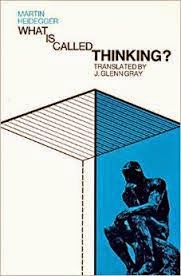
What Is Called Thinking?


What Calls Us to Think? The Thought-Provoking.

The title of the book under review, What Is Called Thinking?, coming from the German Was heisst Denken?, could also have been translated as 'What Calls Us to Think?' or even 'What Calls for Thinking?'. 

The short answer to this question is: that which is thought-provoking and, for the German philosophy professor Martin Heidegger, 'most thought-provoking in our thought-provoking times is that we are still not thinking.'

Readers of the book will find out that the professor includes himself in this 'we'.

At any rate, the book is a transcript of a lecture course Heidegger delivered in the nineteen fifties, and is divided into two parts. 


The first part, in the main, is an appreciation of and confrontation with Friedrich Nietzsche's Thus Spoke Zarathustra—A Book for Everyone and Nobody and the Persian prophet's cry that 'The wasteland is growing. Woe to him who hides wastelands within!', a sentence addressed to the superman, whose nature and difference with the last man is discussed at length in this section.

Essentially, the bridge to the superman is one of renunciation, in the sense of the gentle releasement of being let and of letting be, and manifests in the deliverance from revenge, defined as the '
ill will towards time and its "it was"' rooted in past suffering and, prey to that which has been and cannot be changed, gets frustrated by its incapacity to will backwards. 

Revenge and its most common manifestation, resentment, is essentially an attunement that is at odds with time that wills the world away.

According to Heidegger, the beginning of the modern world began the moment when the type 'man' thought that he was running out of time. 


In learning thinking we are learning to deliver ourselves from revenge and to think our habits in a non reactive way. 

This is no easy task but unavoidable for the advancement of homo sapiens who has been defined by the metaphysical tradition as the animal rationale, 'the beast endowed with reason.'

The second part of the book deals most of all with a fragment from the pre-platonic thinker Parmenides, illuminating in the process the phenomenon of thinking beyond the narrow confines of a shallow rationality content with calculating and representational ideation in favour of a more heart-and-head based approach to reality, but, I would add, not without heeding the words of German poet Friedrich Hölderlin's 'Good Advice':

'You've a head and a heart? Reveal only one of the two for
They'll damn you doubly should you reveal both equally.'

A knowledge of the Greek alphabet and Greek pronunciation is recommended by this reviewer to read through this section of the book since Heidegger always goes back to the original tongue—most usually Greek or Latin—of the thinkers he brings to task and whose fruits he unravels in his immense bibliography.

In conclusion, this book will appeal to profound natures who want to overcome the spirit of revenge which mires our world today and who want to reflect in a way that is deeper and more holistic than the norm. 


It sheds important lights on the modern world bible that is Thus Spoke Zarathustra and puts us to the test; are we willing to learn thinking and heed, in the sense of take seriously, that which provokes us to thought?